Mostrando entradas con la etiqueta side dishes. Mostrar todas las entradas

25.7.07

Super-cheat´s pissaladiére


I´ve just had a minor epiphany over lunch. Like one does. J´s sister had recommended a new sandwich place in the neighbourhood, so there we went to see if the fuss was justified.
We sat at the bar, and read the paper and sipped icy cañas while they made the sandwiches. In every bar they give you a little something with your drink, some olives or chips. What we got here was so good, so much better than any platonic ideal of any chip or olive or pincho. On the face of it, it was some sort of pissaladiére. However, my keen nose for a shortcut quickly detected the truth. What we are dealing with is a measure of genius of the sort I admire.
This was a torta de aceite of the sort they sell at Viena Lacrem, smeared with a mixture of grated tomato, mashed anchovies and a dash of oregano.
Provided you have ready access to this type of bread, which I think is nothing more sophisticated than a focaccia type of dough that is fried instead of baked, you´re nanoseconds away from heaven.
If not, well, you can make some pizza bases and fry them, of course, but I´m not sure with all that effort the whole thing might become a bit pointless and exponentially less delicious.
You´d be better off sticking with a normal cheat´s pissaladiére, as seen on Lindsay Bareham´s The fish store, or this post of mine from last year.
The sandwiches were excellent, so I´m proud to recommend "El burgado" bocadillería gourmet. c/ Espíritu Santo, 40. 91 521 28 77.
Viena Lacrem, as ever, still reigns supreme over all bakeries in Madrid from its tiny hole-in-the-wall at c/Santa Brígida 6.

24.7.07

Salpicón: seafood salad


Salpicón is one of the best things of the summer. It´s more of a bar food, of the sort that nestles in chilled trays on the bar. If you´re lucky, it will have whatever caught the cook´s fancy that morning at the market. If not, it´ll have been made on Monday with the sweepings of the fridge, and will have languished ever since. Caveat emptor.
In theory, salpicón is a vinaigrette made with three parts olive oil to one of sherry vinegar, and peppers, onions and parsley, chopped very small. Maybe tomato, too, and probably chopped egg ( I told you it was everywhere).
In practice, it´s more of a salad. The chopped vegetables make a substantial base note for a star ingredient, whichever it may be. The most typical is a mixture of seafood, prawns, mussels, octopus. Lobster, maybe, at the top end of the scale, surimi at the bottom. With potatoes, it becomes ensalada campera, or papas aliñás, and is one of the best possible potato salads, I think.
Fish roe is also a favourite, or beans, or salt cod. The variations are almost endless. Just walk into a bar, ask what aliño they have, and have a tapa sent round with your beer. It´s wonderful, and unique in the Spanish canon in its overall healthiness and lack of pig-parts.

Salpicón
Mince two shallots, finely dice one big red pepper, chop a good fistful of parsley leaves. The tomatoes don´t have to be as finely diced. Mix these with the 3/1 olive oil and sherry vinegar , and leave to mingle. Yes, the tomato will make a lot of liquid, but don´t we all love our pot likker?
Make a couple of boiled eggs using the 12 minute method. Thanks to everyone who left it in my comments box. I am a born-again boiled egg lover.
The seafood can be whatever you have on hand. Leftover crab, maybe, or a can of good tuna or sardines, or around 250 gr. steamed prawns. Whatever suits you best. I also love it over beans. In fact, I made salpicón to trick out this recipe from Mark Bittman´s 101 from last week´s NYT.
4 Open a can of white beans and combine with olive oil, salt, small or chopped shrimp, minced garlic and thyme leaves in a pan. Cook, stirring, until the shrimp are done; garnish with more olive oil.
I found it a bit bland, but left to cool, and then mixed with the salpicón and a couple of tomatoes, it was beyond delicious.
The only important rule you should never forget is to mix it a few hours ahead, and leave it in the fridge, well covered, so that flavours have time to mingle. And eat it in the day. It´s meant to be super-fresh and crunchy.

19.7.07

Pa amb tomàquet: Catalan tomato bread

Now, now, don´t you all start grumbling. I know what you´re going to say. Where does she get off, telling us how to rub tomato on a piece of bread? And, also, that´s some nerve, writing about Catalan tomato bread from enemy territory. Madrid, no less!
Well, you´ll have to forgive me. And catalanes won´t mind, I´m sure. Intercity and sporting rivalry nonwithstanding, even the most diehard madrileño will admit that when it comes to bread and tomatoes, they´re the best. We´ll argue Gaudí, and the beach, and the football, but not the pantumaca.
I learnt how to make pa amb tomàquet in Florence, Italy. Silly, no? I was doing a watercolour course there, and the school arranged accomodation with us. By chance, one of our flatmates was from Barcelona. She it was who initiated me.
I´d spend every morning going to all the galleries and the churches, trying to not wilt in the humid heat, and the afternoon drawing. Our evening ritual was to sit chatting in the shady garden and go through whole bags of tomatoes.
In Sevilla, where I lived then, toast with tomato is made by dousing a piece of bread with olive oil, topping it with slices of tomato, and sprinkling some salt.
The Catalan way is different.It only works with the best, ripest summer tomatoes, so don´t even bother otherwise. And yes, go right ahead and rub garlic first if you like. I think that calls for prior negotiations with everyone in the house, but each to their own.
So, what happens is, the tomato is cut in half , squeezed to let excess juice out, and then rubbed on the bread. Then, and listen up, because I found this pretty strange, you sprinkle the salt. And only at the end do you pour a trickle of olive oil on top. This way, the bread soaks up mostly tomato juice, the salt is quickly absorbed by the tomato, and the little oil sits on top, making all look glossy and beautiful. It´s healthier, and well in keeping with the Catalan tradition of thrift and good graphic design.
Marta, my friend from Barna, who will be on the receiving end of any indignant emails from her native land, also taught me the cheat´s method.
You take the tomatoes, cut them in two, grate them so that you just have pulp in a bowl. Then you salt and oil that, and put it on a table with the bread. People just spread the tomato when they want the bread, and it doesn´t go soggy. With a tortilla, or some jamón or caña de lomo, or tuna, it´s the perfect food for watching a Madrid-Barça match.
And if you´re thinking I´m going to say may the best team win, you´re outta your mind.

11.7.06

Mushrooms baked in vine leaves


Of all the stuff I picked over the weekend, the most exotic by far, for me, have been the vine leaves.
I´d never seen them used, except to make dolmades. And the mere idea of tackling something so time consuming is enough to send me into a swoon. I try not to roll and stuff too many things, for the sake of my mental health.
Then last year I read a recipe in Elisabeth David´s
 Of pageants and picnics (best title ever?), and was very intrigued. Sceptical , even.
She claimed that baking ordinary button or flat mushrooms with vine leaves would make them taste wild and woodsy and utterly different. Of course I deeply respect la David for the giant of gastronomic culture she is, but I thought here she was just trying to be cool and Mediterranean.
But since I happened to be in the country at the time, reading her book under an actual trellis of vine leaves, I thought, why not?

And I was instantly converted. It´s my kind of favourite recipe, the sort that is almost not a recipe but a set of recommendations. As long as you have vine leaves, the process is simple in the extreme, and the outcome, just as surprisingly good as was promised.

I´ve lost the book, since it´s one of those flimsy paperbacks that are easily swallowed by sofas, left on trains, or forgotten in the pocket of a winter handbag. But luckily I was so taken by the recipe that I wrote it down in my favourite recipes notebook.

Preheat the oven to 200º. Boil water, and blanch the leaves for about a minute. Drain.

Clean the mushrooms, and cut the stems off. Line the bottom of a baking dish with half the vine leaves. Put the mushrooms on top, the caps in one piece, and the stems on their own , and a few whole garlic cloves scattered in between. Add salt and pepper, drizzle with olive oil and cover with a second layer of leaves.
Cover the tray . I use an earthenware round dish that´s the same size as a cooking pot, and the lid fits perfectly, but you can cover it with foil.
Leave for about an hour.

4.7.06

Fear of frying:eggs and chips


Sometimes I think frying is the national sport.
People love it. They fry letf, right and centre.
They fry fish, they fry meat, they fry dough. They stuff things and fry them . They layer fried things and bake them. They fry so much, sometimes you come out of restaurants or even people´s houses smelling like they fried you.

It´s supposed to be convenient, and widely assumed that things take seconds to fry. And they do, but only one. When you have to feed 4 or 6 people with things that have to be fried, that´s at least an hour of standing over a hot stove.

But people don´t mind that. I´ve seen this time and again. Someone turns up unexpectedly, and instead of being offered pasta, or soup, or a sandwich, preparations are inmediately started for chips and fried eggs.

Because if ever there was a love affair, it´s that of the Spaniard and his fried egg. They are the true national dish, and never mind paella. I dare you to find a bar that doesn´t have them on every plato combinado, nestling up to croquetas and russian salad.
It makes sense, in a way, since we do produce the best olive oil in the world, and olive oil is the best fat for frying.
Or so they tell me.
I don´t fry, myself. I´m too scared.

For the true fried egg of legend, the perfectly round, lacy crisp golden egg of platonic ideal, you need a pool of boiling oil. And the egg has to be dropped from a height, so it is full submerged and the oil can splash over it inmediately.

See what I mean? Only the brave. I just cannot do that. Things spit and hiss and splutter, and I lose my nerve.
You have to approach the fried egg with confidence. They smell your fear. If you don´t arrive at the stove with a masterful mind, the egg will sense it, and begin to sputter fiercely, and even maybe catch fire.

Not for me.
When I want a crisp potato, crunchy and golden, to break a creamy orange yolk, here´s my answer.

OVEN CHIPS WITH POACHED EGGS

Preheat the oven on its highest setting.

Scrub 2 potatoes and cut them into wedges, without peeling.

Put them in a bowl with a spoonful or so of oil, a good pinch of pimentón (sweet or hot, as you like), plenty of black pepper, and salt.
Toss them so they´re slicked over with the oil, and put them on a baking tray and in the oven.

Wait till they´re cooked and crisp, around 20, but maybe more.
Eat them straight away, blowing on your fingers, breaking the yolks of the poached eggs, and making sure to scrape all the yellow goodness with more potatoes.

2.7.06

Winding down on a friday evening : Pisto


On Friday I was pretty much beat. Totally and utterly tired out by a long week of non-stop deadline meeting.

José was pretty done up too. He decided to go out and buy some pizzas. He´s lately fallen in love with a new Italian takeout store.I decided to stay, too lazy even to chose a pizza topping.

But I didn´t want to sit still, either. What I needed was the kind of mindless, soothing task that would occupy my hands and feet, but hardly my brain. Something involving a good amount of easy chopping, a bit of stirring, which could then be left to cook away, when I´d had enough.
In short, pisto.

Pisto is the perfect do ahead recipe. You make it , it keeps well in the fridge, waiting it´s time for the day when you really don´t want to cook, at all.
It freezes perfectly. Apart from its time-honoured traditional use, with eggs and white rice, I love it on pasta. On pizza. In empanadas. With fish. With meat. On its own, straight out of the jar, standing in front of the open fridge.

What I like about it is that it has a very relaxed rythm. You only have to follow the order of ingredients, and throw them in the pan as soon as they´re chopped. There´s no anxiously waiting for something to be just right, no stressful wild chopping while something may burn. Things will happen while they must, and a minute up and down isn´t a big deal.

Another thing is that there´s one of each, so you don´t get bored. I love chopping veg, but can become restless at the third courgette.

By the time José was back with the pizzas, the pisto was on the simmer phase and I could sit back comfortably and watch Italy get through to the semifinals. Again. Dammit.

Pisto manchego

1 garlic clove, 1 big onion, 1 courgette, or two small ones, 1 red pepper, 1 kilo tin of tomatoes.

First, chop the garlic and onion. Cover the bottom of the pan with enough oil to coat it comfortably. When it´s hot, add the onion and garlic. While they soften, dice the red pepper. Green is the traditional, but I love the soft, almost creamy sweetness of the red. When it´s diced , add to the pan.
While that softens, cut the courgette into bite sized chunks. I like the courgette to remain recognizable. Add. Stir a little.
Open the tin of tomatoes, and squish them and remove the hard cores. Or grate the equivalent amount of ripe plum tomatoes.
Add them to the pan, with some salt, a couple of heaped tablespoons of sugar, a small dried chilli pepper and some oregano.
Lower the heat, and leave to simmer for forty minutes to an hour. You may need to use a heat diffuser if it starts to stick. When it´s thickened, the courgettes are soft, and the tomato tastes fully cooked, you´re done.


Bear in mind that this recipe is how I make it, and not the classical orthodox one. But it is the most comfortable, and I´ve never had any complaints. Tradition calls for a frying pan, but unless you´re devoted to cleaning tomato stains from the wall and ceiling, I advise a wide saucepan, the sort that´s not very high.
You can add aubergine after the courgette, but then it won´t be pisto but ratatouille.

27.5.06

More tomatoes


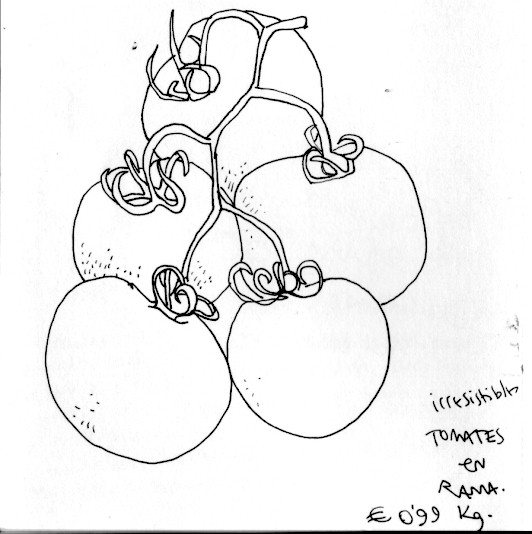
I´m a sucker for a god looking bunch of tomatoes. Usually I buy way more than I need, and I don´t mind, because I like the way they look on my white table. I may sketch them if I have time. And if I have time, I will make any of a million different things with them.
But if I don´t have time, or if I need to get them out of the way before I succumb to the next gorgeous looking lot, I roast them.
In they go, into a roasting pan where they will fit snugly. I drizzle some olive oil over them, some salt, maybe some oregano. I put them into a hot oven, and forget about them, more or less.
After an hour they´ll be pretty much cooked, and can be used. But I prefer to squish them a little, sprinkle some brown sugar over , and leave them there for another hour, or two in a slightly less hot oven.
When they´re done,and cooled, I either put them in a glass jar in the fridge, or I freeze them. They´re very handy to have around.
By the way, if I seem annoyingly vague about oven temperatures, it´s because my oven doesn´t have any. No gas marks either. Baking is a high anxiety business for me.

18.5.06

Asparagus


We´ve been eating quite a few bunches of asparagus this spring. I do love them.
And I love the trick where they snap on their own just at the place where you have to cut them because they´re too fibrous.And I like eating with my hands.
We´ve had them steamed, and then dipped in mayonaise or in vinaigrette. Once I went so far as to try hollandaise and it was heavenly.
I´ve done risotto, and asparagus soup, and thought I´d make a quiche but was too greedy and ate them before that could happen.
I´ve roasted them, and boiled them.
But my favourite method, so far, has been to pan-steam them.
You take a non stick pan with a lid. Put some olive oil on it, very little will do. Put the spears in , and leave them for a minute. Then cover , and leave two to five minutes, depending on the thickness.
This is quick, unfussy, and gives you a crispy burnt asparagus that is also juicy and that cooks very fast.

Share